The Silent Failure of Retaining Walls: Why Filter Fabric Dictates Lifespan
Most retaining wall failures in Western Pennsylvania do not stem from a lack of structural block or stone; they are caused by the slow, invisible migration of soil into the drainage zone. When native clay soils mix with clean drainage stone, the resulting "slurry" creates an impermeable plug that traps water behind the face of the wall. This trapped water exerts massive hydrostatic pressure, eventually pushing the wall out of alignment or causing total collapse.
This technical guide examines the mechanics of non-woven geotextile for retaining walls, the specific material required to maintain a functioning drainage "chimney." Whether you are managing a slope in Mt. Lebanon or stabilizing a tiered backyard, understanding the separator layer is essential for transforming a potential liability into a long-term asset.
Why Drainage Systems Clog Without Filtration
Gravity-fed drainage relies on the voids between clean stones to move water away from the wall. In the Pittsburgh region, where soils are often heavy with clay and silt, the following failures occur when filter fabric is omitted or installed incorrectly:
- Soil piping occurs as water carries fine particles into the gravel backfill, filling the air gaps meant for water flow.
- The effective weight of the backfill increases significantly as it saturates, exceeding the original engineering assumptions.
- Freeze-thaw cycles exert outward pressure on the wall blocks when the drainage stone is holding water rather than shedding it.
- Surface sinkholes appear behind the wall as the native soil is physically "washed away" into the stone and out through the wall joints.
The Geotextile Installation Framework
1Select non-woven over woven materials
Woven geotextile is primarily used for stabilization and load-bearing applications, such as under driveways (profabricsupply.com). For retaining walls, non-woven needle-punched geotextile is the correct choice because its filtration performance is superior, holding back fines while allowing water to pass through (landscapediscount.com).
2Line the entire trench interface
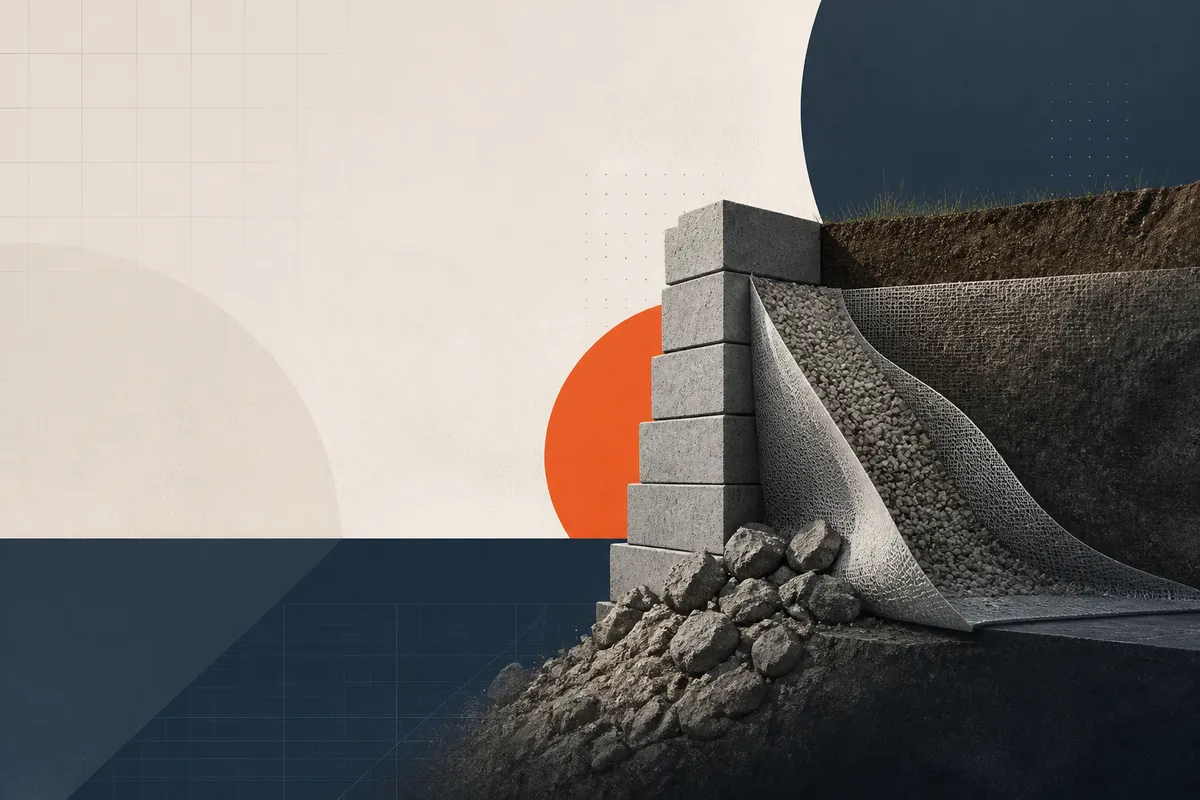
The fabric must act as a complete envelope between the native soil and the clean stone. It is placed against the excavated "cut" of the hillside and wrapped over the top of the stone columns before the final layer of topsoil or mulch is applied. This ensures surface water can permeate through the fabric and into the clean stone and drainage pipe (youtube.com).
3Maintain adequate overlap
Geotextile sections should overlap at every seam to ensure that shifting soil cannot find a gap. In areas with high water tables or steep slopes, maintaining a generous overlap ensures the "chimney drain" remains isolated from the surrounding earth, preventing soil particles from entering the drainage stone (shawnslandscape.com).
4Protect the fabric during backfilling
While geotextiles are engineered to improve the performance and durability of construction projects (blog.whitecap.com), they can be punctured by sharp, large-diameter rocks or heavy machinery. Stone should be placed in lifts and compacted carefully to avoid tearing the "filter," which would immediately introduce a point of failure for soil migration.
The Physics of Soil Migration
The preventing soil migration in walls process relies on a principle called "filter cake" formation. As water initially flows toward the wall, a tiny amount of fine soil settles against the fabric. These particles actually help create a secondary natural filter layer against the geotextile.
Because the fabric has high permittivity, the water continues to flow through this layer and into the gravel. If the fabric were not there, these fines would travel several inches into the gravel, settle at the bottom, and harden into a concrete-like substance that prevents the perforated drain pipe from ever receiving water.
How Retaining Wall of Pittsburgh helps
A standard scope of work for wall construction or stabilization involves a detailed drainage plan that accounts for the specific soil types of the region. This typically includes the excavation of a drainage bench, the installation of a perforated pipe at the base of the wall, and a full vertical column of clean angular stone. A practitioner will verify that the non-woven geotextile for retaining walls is positioned to separate all native earth from this stone column. If you are noticing water seeping through the face of your wall or seeing the wall lean, call (412) 674-2900 to discuss a site evaluation and drainage correction.
Frequently asked questions
Can I use plastic sheeting instead of filter fabric?
No, plastic sheeting is impermeable and will trap water behind the wall, which is the leading cause of catastrophic failure. Filter fabric is specifically engineered to be permeable to water but impermeable to soil particles (shawnslandscape.com).
Do I need a permit for a wall that uses this drainage system?
According to pittsburghpa.gov, retaining walls 4'-0" or less in height, measured from the lowest level of grade to the top of the wall, do not require a building and development application, unless supporting a surcharge. However, even these smaller walls require proper geotextile filtration to prevent clogging.
How long does non-woven geotextile last underground?
Most high-quality non-woven fabrics are made from polypropylene, which is inert to soil chemicals and biological degradation. These engineered materials are designed to improve the long-term performance and durability of construction projects when properly buried (blog.whitecap.com).
Can I use the same fabric I use for weed control?
General-purpose weed barrier is often too thin and has a low flow rate for structural drainage. Retaining wall applications require a specific needle-punched non-woven geotextile to handle the volume of water and act as an effective filter for soil particles (waterproofspecialist.com).
Is filter fabric necessary for boulder or natural stone walls?
Yes, because natural stone walls have large, irregular gaps, soil migration is even more prevalent than in segmental block walls. The fabric prevents the soil from washing out through the "face" of the wall, which can cause the stones to settle and become unstable over time.
What happens when you get in touch: you describe the situation, we ask the few questions that actually change the answer, and you get a clear scope and next step — no obligation.