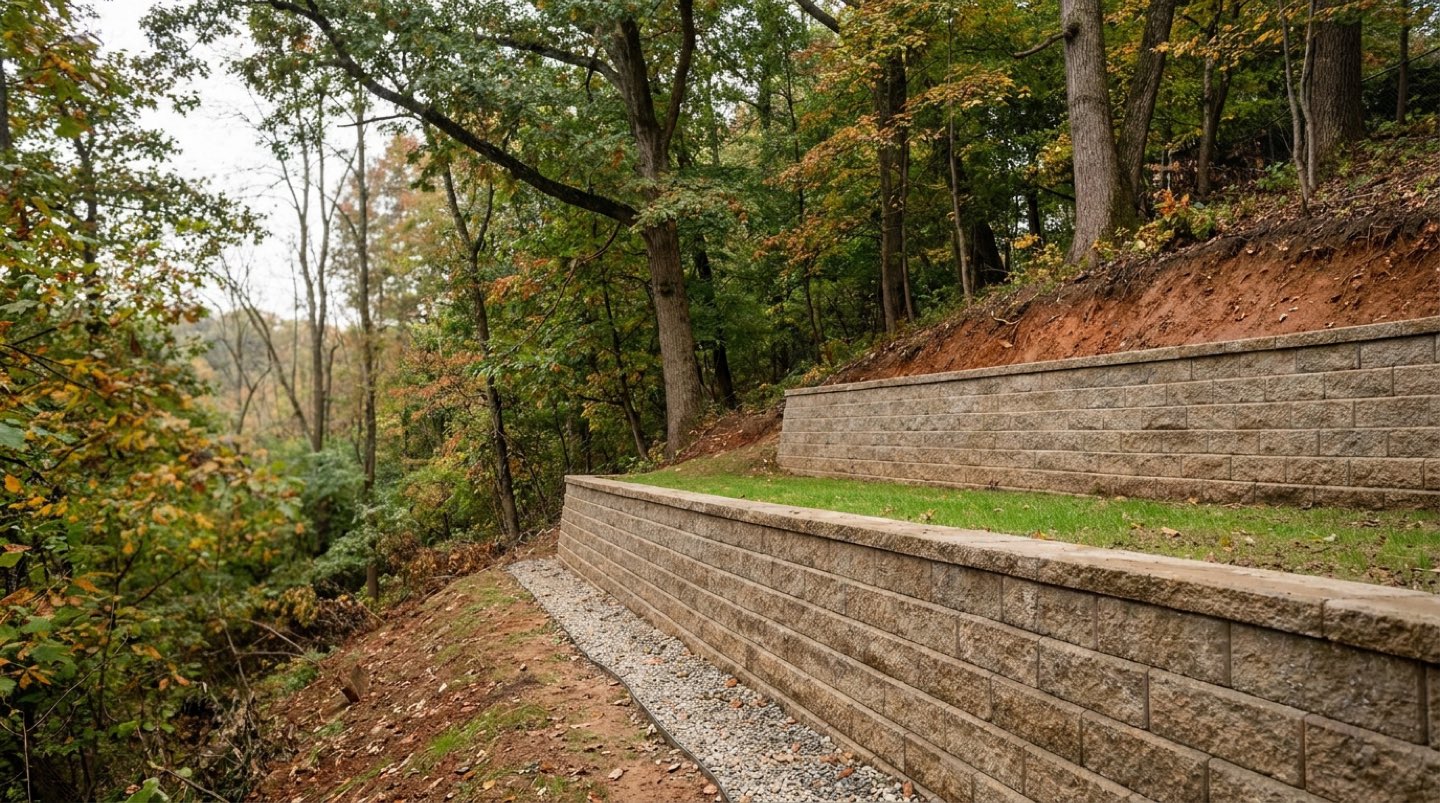
A two-tier segmental block retaining wall terracing a steep wooded hillside, with a gravel drainage course at its base and exposed red-brown clay in the cut slope above.
Free on-site estimates across Allegheny, Butler and Washington counties

Retaining Walls Built for Pittsburgh Hillsides

Red-bed clay that swells when it's wet. Lots that fall away behind the house. A wall here isn't holding dirt, it's holding a hill that's already trying to move.

Free estimates. Written scope before any work starts.

FreeOn-site estimates
Walls OnlyNot a landscaping sideline
DrainageQuoted with the wall, never extra
WrittenScope before work starts

We've Seen It Before

What a Failing Wall Looks Like

A wall rarely fails all at once. It leans, then cracks, then bellies. Each one names a different cause.

The Wall Is Leaning Out

Most walls fail this way first. Water builds pressure behind a wall with nowhere to drain, and the top course walks outward before anything cracks.

Cracks Running Through It

Stair-step cracks mean the base has moved. The block is a symptom; the footing and the soil under it are the problem.

Bulging in the Middle

A belly in the face means the reinforcement behind the wall has failed or was never there. Repointing the front does nothing.

Water Pooling Behind It

Standing water, a soggy terrace, or a spring that shows up after rain. Left alone, this is what takes the wall down.

Our Services

Retaining Walls, Drainage and the Ground Work Between

Segmental block, boulder, natural stone and poured concrete. What the wall holds and how the site drains decides the material.

Why Choose Us

Why Pittsburgh Homeowners Call Us

Most failed walls in this city were built correctly for somewhere else. The ground here decides whether a wall lasts thirty years or three.

Drainage Is Part of the Wall

Stone, fabric and an outlet are in the quote, not added later. It's the difference between a wall that lasts and one that leans.

We Diagnose Before Quoting

We look at why a wall moved before pricing a rebuild. Rebuilding on the same failed drainage buys the same failure again.

Walls Are All We Do

No mowing, no mulch, no driveways. Retaining walls, drainage and the excavation to reach them.

A Written Scope

Height, length, material, base depth, drainage and reinforcement, itemised before anything is dug.

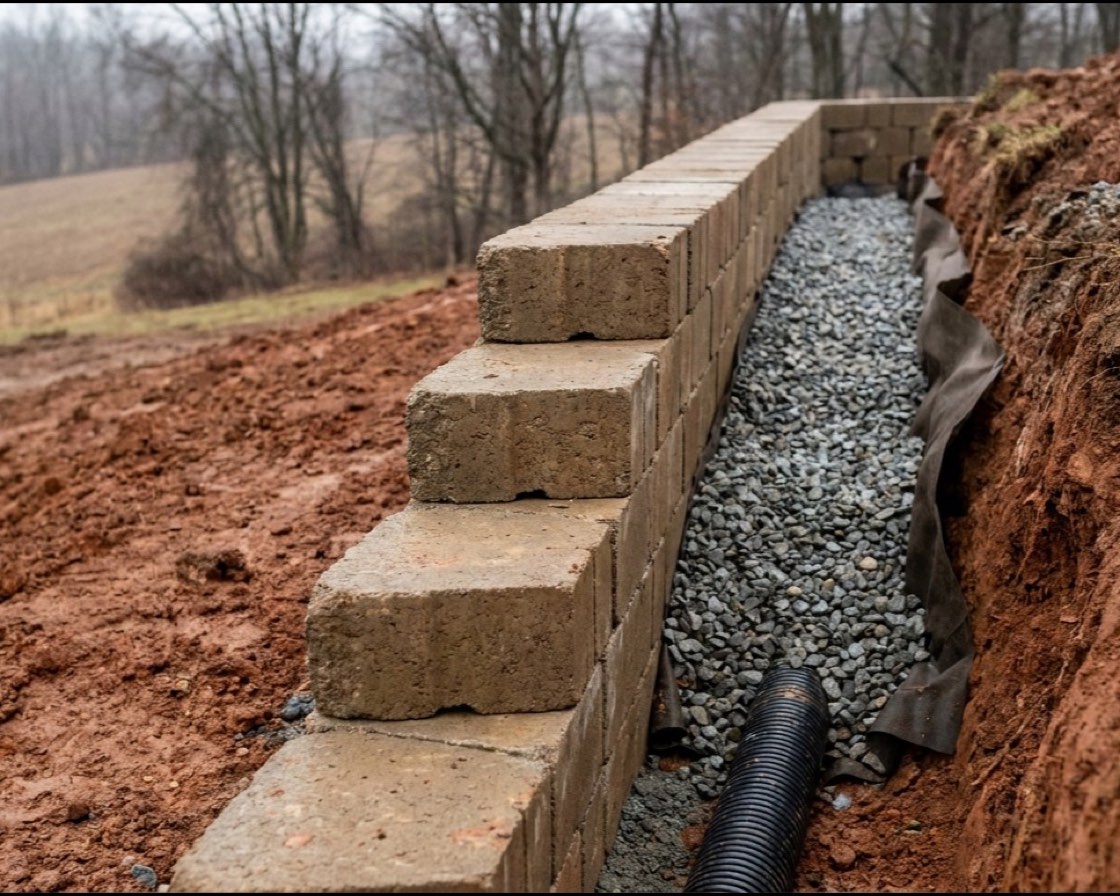
Segmental block retaining wall part-way through construction, with clean drainage stone, filter fabric and a perforated drain pipe visible behind the courses against cut red clay.

Our Process

From Call to Backfill

Four steps, and you see the number before anything is dug.

Call or Send Photos

A picture of a lean or a crack usually tells us more than a paragraph.

We Walk the Site

On-site, not over the phone. The slope above and below, and where water currently goes.

Written Scope and Price

Itemised. If the wall needs an engineer's stamp, you hear it now, not after the dig.

We Build and Clean Up

Base compacted, courses reinforced, drainage installed, backfilled, ground restored.

Free - No Obligation

Get Your Free Estimate

Send a few details and we'll come look at it. Photos help - a picture of a lean or a crack tells us more than a paragraph.

  • On-site visit, no charge, no obligation
  • Written scope before any work starts
  • One price, approved by you first
  • We'll tell you if you don't need a new wall

Request a Free Estimate

(412) 674-2900

Wall Moving? Get It Looked At.

A lean gets worse every wet season. Send a photo and we'll tell you whether it's a repair or a rebuild.

Service Areas

Retaining Walls Across Western Pennsylvania

Based in Pittsburgh, working Allegheny, Butler and Washington counties.

Not listed? Call anyway - if we're already on that side of the county, we'll come look.

FAQ

Common Questions About Retaining Walls

Why do so many retaining walls fail in Pittsburgh?
Two reasons, and they compound. Much of Allegheny County sits on red-bed clay that swells when it takes on water and shrinks as it dries, and hillside lots mean a wall is resisting a load already moving downhill. A wall with no drainage absorbs all of that directly.
My wall is leaning. Can it be repaired, or does it need rebuilding?
It depends on how far it has moved and why. A wall that has walked out at the top with a sound base can sometimes be taken down and reset. Once the base has shifted or the face is bellied, rebuilding is usually the honest answer. We'll tell you which one you're looking at.
Do I need a permit for a retaining wall?
Requirements vary by municipality, and taller walls generally trigger review and an engineer's drawing. We'll tell you at the estimate whether your wall is likely to need one rather than after the dig starts.
What's the difference between block, boulder and poured concrete?
Segmental block is the workhorse for most residential walls. Boulder suits irregular grades and wooded lots. Poured concrete handles tall walls and anywhere a driveway or structure sits close behind. The site usually picks the material, not preference.
Why does drainage matter so much?
Water with nowhere to go is what takes walls down. Clean drainage stone, filter fabric and an actual outlet do more for a wall's life than the block on the front of it ever will.
What is geogrid, and does my wall need it?
Geogrid is reinforcement laid back into the soil in layers as the wall goes up, tying the wall to the ground behind it. Taller walls and slopes above them generally need it. A wall built without it where it was needed is the classic bulge.
Can you fix just the section that moved?
Sometimes. If the rest of the wall is sound and the cause is local, a partial rebuild is reasonable. If the same drainage problem runs the length of the wall, patching one section just moves the failure along.
Do you charge for an estimate?
No. We come out, walk the site and give you a written scope at no charge.
Get a Straight Answer on Your Wall

On-site estimate, written scope, one price you approve first. Serving Pittsburgh and Western Pennsylvania - Mon-Sat, 7am to 6pm.

Call Now Free Estimate